
The Trap of Pop Psychology: Understanding the Difference Between Quirks and Diagnosis
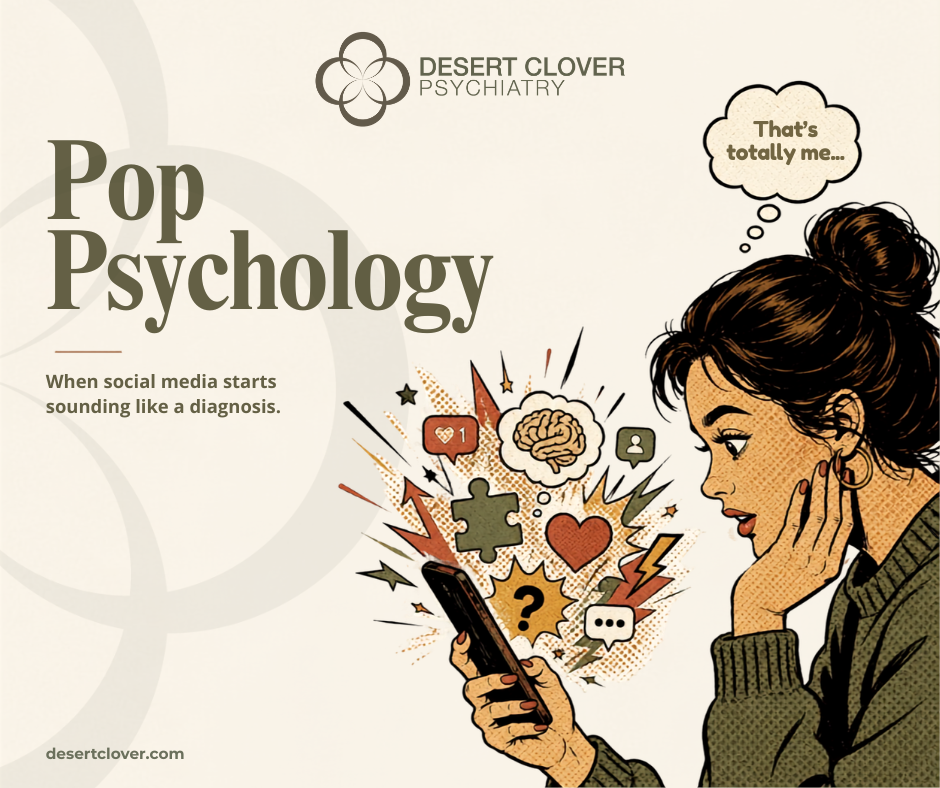
If you spend any time scrolling through social media, you’ve almost certainly encountered them: quick, highly relatable, 30-second videos where an energetic creator points at the screen and tells you that if you "always lose your keys," "bite your nails," or "like your desk organized," you might actually have ADHD, anxiety, or OCD. Under hashtags like #ADHD and #Autism, which have racked up tens of billions of views, complex neurodevelopmental and psychiatric conditions are boiled down into bite sized, everyday quirks.
Suddenly, clinical buzzwords like executive dysfunction, stimming, narcissist, and trauma are being thrown around like confetti. It can be deeply comforting to watch these videos, spot a behavior you recognize, and feel an immediate spark of self-discovery. But there is a massive difference between pop psychology designed for viral engagement and actual clinical evaluation. While digital communities can provide incredible validation, a relatable trait is not a medical diagnosis.
"Dr. TikTok" Is Having a Moment
Searches for "mental health" on platforms like TikTok have surpassed 67 billion queries, positioning social media as a primary, unregulated source of psychiatric discovery. Yet, the quality of this information is alarmingly poor.
A 2026 systematic review published in the Journal of Social Media Research evaluated 27 individual studies analyzing over 5,057 social media posts across various platforms (Carter et al., 2026). The findings expose systemic inaccuracies:
Neurodevelopmental and neurodivergent-related content is particularly vulnerable. Up to 52% of highly viewed ADHD videos and 41% of autism-related videos on TikTok were classified as scientifically unsubstantiated or misleading.
The review noted that misinformation regarding evidence-based treatments, such as cognitive behavioral therapy (CBT), is actively promoted, with both unqualified laypeople and self-proclaimed professionals falsely claiming CBT is harmful or ineffective.
A cross-sectional study in The Canadian Journal of Psychiatry, which analyzed popular ADHD content and confirmed that 52% of top-performing videos lacked scientific accuracy: (Yeung et al., 2022).
Larger clinical evaluations of overall mental health advice on social media have found even more staggering error rates. In a comprehensive review of mental health advice on TikTok, medical professionals determined that Approximately half of the analyzed TikTok videos about ADHD were misleading.
This statistical flood of misinformation is directly tied to a lack of clinical authority. In fact, 91% of creators giving advice had no relevant medical qualifications.
The Craving for Validation and Identity
Human beings are hardwired to seek belonging. When you struggle with focus, social interactions, or emotional regulation, finding a label can feel like finding a key. It reframes what you might have previously viewed as a personal failure ("I am lazy or broken") into a neurodevelopmental explanation ("My brain is wired differently"). This shift from shame to self-compassion is powerful and genuinely healing.
The "Lost Generation"
Historically, diagnostic criteria for ADHD and autism were heavily based on studies of young, school-aged boys. As a result, a "lost generation" of women, individuals of color, and adults went entirely undiagnosed. Many learned to "mask," consciously or unconsciously hiding their traits to fit societal expectations. For adults who have spent decades wondering why life feels uniquely difficult, stumbling upon neurodivergent content online can feel like the first time they have ever been truly seen.
Social media platforms do not reward scientific nuance; they reward shareability, retention, and confidence. To make a video perform well, a creator must make their content as broadly relatable as possible. In doing so, they often take "transdiagnostic symptoms" (behaviors that occur across several different mental health conditions, or are simply part of the normal human experience) and market them as exclusive, core signs of a specific disorder.
The "One Trait" Trap
The internet loves to oversimplify. In the world of online labels, one negative interaction or one quirky habit is often instantly equated to a full-blown personality disorder or neurodivergence. For example:
Someone ghosted you after a first date? They must be a narcissist!
You like your books arranged by color? You definitely have OCD.
You feel sad on a rainy Tuesday? That's clinical depression.
This formula, One Trait = A Disorder, is fundamentally flawed. Human beings are complex. We all have moments of selfishness, periods of sadness, and specific preferences for how we navigate our daily lives. Having a relatable, normal human experience does not mean you have a pathology that requires a clinical label.
The Hard Truth: Misinformation in Your Feed
While the reduction of stigma is a massive win, the sheer volume of misinformation online is a growing clinical concern. Recent research demonstrates just how widespread this issue has become. In a landmark cross-sectional study analyzing the quality of ADHD content on TikTok, researchers found that approximately 52% of the most-viewed videos contained highly inaccurate, misleading, or clinically unsubstantiated claims (Yeung et al., 2022).
Furthermore, the impact of this content stretches beyond mere misinformation. Emerging peer-reviewed research indicates that increased consumption of brief, algorithm-driven mental health content is significantly associated with users overestimating the severity of their symptoms, which frequently drives unsubstantiated self-diagnosis in lieu of professional clinical evaluation (Karasavva et al., 2025). When platforms analyze thousands of psychiatric posts, the trend remains troubling: systemic disinformation on complex psychiatric conditions often outpaces evidence-based facts, presenting everyday behaviors as pathologized symptoms (Hudon et al., 2025).
The issue isn't just that these videos are occasionally wrong; it is that they lack context. Short-form media is structurally incapable of conveying the diagnostic depth required to understand these conditions. When a video claims, "If you do X, you are autistic," it skips past the critical clinical realities of history, severity, and differential diagnosis.
The Overlap Pitfall: Why One (or Even a Few) Traits Is NOT A Diagnosis
The core mistake of pop-psychology self-diagnosis is looking at a trait in a vacuum. In clinical practice, symptoms are incredibly complex, and they rarely exist in isolation. Many psychological experiences share massive overlap, a phenomenon known in medicine as comorbidity or symptom overlap.
| Shared Symptom / Trait | ADHD | Generalized Anxiety | Complex PTSD |
|---|---|---|---|
| Inattention & Brain Fog | Core feature of executive dysfunction | Driven by constant worry and cognitive fatigue | Caused by hypervigilance and survival mode |
| Restlessness & Agitation | Physical or mental hyperactivity | Somatic tension and inability to relax | Trauma-induced hyperarousal response |
| Emotional Dysregulation | Impulsive emotional responses | Fear-based reactions and overthinking | Chronic emotional triggers and flashbacks |
|
Primary Influencing Factor
Everyday Stress & Sleep Deprivation directly mimics, triggers, or severely worsens symptoms across all three of these conditions. |
|||
Consider how easily everyday experiences or alternative diagnoses can mimic neurodivergence:
Inattention & Brain Fog: While a hallmark of ADHD, chronic inattention can also be caused by generalized anxiety, clinical depression, complex PTSD, thyroid disorders, or simple sleep apnea.
Social Withdrawal & Sensory Sensitivity: A person might experience intense overwhelm in crowds. While this is common in autism, it is also a primary symptom of social anxiety disorder, sensory processing sensitivity, or hypervigilance stemming from trauma.
The Danger of Mislabeling: If you incorrectly self-diagnose your chronic, trauma-induced hyperarousal as ADHD, you may adopt coping strategies that don't address the root cause, leaving you feeling frustrated and delayed in seeking the specific therapy or care that would actually help you heal.
The Danger of Trending Terminology

Content creators know that diagnostic buzzwords get views. Slapping a severe label on an everyday annoyance is a guaranteed way to go viral. However, treating clinical terms as trendy adjectives waters down their meaning and minimizes the struggles of people who are actually living with these debilitating conditions.
Worse yet, it harms the person doing the self-diagnosing. While self-reflection is a wonderful tool ("I noticed I shut down when I get angry; I can learn from this and grow"), premature self-diagnosis often misleads. It can leave you feeling scared, confused, and boxed into a label that doesn't actually fit you, ultimately causing you to avoid seeking the real, professional help you actually need.
What a Real Clinical Assessment Looks Like
Mental health professionals do not diagnose based on a checklist or "vibes" from a three minute video hook. A robust clinical evaluation for ADHD, autism, or any mental health condition is an evidence based, highly individualized, and extensive process. It involves examining a complex intersection of factors:
Developmental History & Pattern: Neurodevelopmental conditions do not suddenly appear in adulthood. A clinician must establish that symptoms were present in childhood, even if they were successfully masked or managed at the time. Is this a consistent behavior repeated over a long period of time?
Pervasiveness: The traits must manifest across multiple settings of your life (e.g., school, work, home, and personal relationships), not just when you are feeling stressed at work.
Severity and Impairment: This is the most crucial clinical threshold. Everyone experiences occasional forgetfulness or sensory annoyance. For a diagnosis, these symptoms must cause significant distress or clinically measurable impairment in your daily functioning, relationships, or ability to maintain employment.
Differential Diagnosis (Context): A professional must carefully evaluate and rule out other potential psychological, environmental, or physiological explanations for your symptoms. What else is going on in your life that might explain this behavior?
Moving Forward: Actionable Steps for Self-Exploration
If you have watched online content and deeply connected with descriptions of ADHD or autism, your experience is valid. You are experiencing real struggles, and they deserve attention. However, instead of immediately applying a permanent diagnostic label, treat your online discovery as an invitation to self-exploration. Here is how you can navigate this experience safely and find real value:
Step 1. Shift from Self-Diagnosis to "Self-Inquiry"
Instead of saying, "I have ADHD because of this video," try framing it as, "I highly relate to how executive dysfunction is described here. Let me track how this actually shows up in my daily life." Treat it as a clue, not a conclusion.
Step 2. Keep a "Symptom & Context" Journal
Before seeking a professional, begin documenting your experiences over a period of 2 to 4 weeks. Note:
What did you experience? (e.g., "Struggled to initiate a task for three hours.")
What else was happening? (e.g., "I only slept four hours last night and have a major deadline tomorrow.")
Has this been a consistent pattern since childhood?
Bringing this journal to a professional provides incredibly rich, objective data that speeds up and clarifies the assessment process.
Step 3. Implement Strategies, Regardless of the Label
You do not need a formal diagnosis to use supportive tools. If an ADHD-focused organization strategy, a sensory accommodation, or a mindfulness exercise helps you manage your day, use it. Coping skills do not require a prescription or a diagnostic code to be effective.
Step 4. Consult Evidence-Based, Reputable Resources
If you want to deepen your understanding, step away from the social media scroll and read high-quality, scientifically vetted materials.
Reputable Clinical Organizations
National Institute of Mental Health (NIMH) ADHD Page: Expert-reviewed scientific overviews of ADHD symptoms, treatment, and ongoing research.
Centers for Disease Control and Prevention (CDC) ADHD Portal: Comprehensive, research-backed guidelines, prevalence data, and family toolkits.
Vetted Clinical Screening Tools (as educational starting points):
Adult ADHD Self-Report Scale (ASRS): The standard, science-backed 6-question screener used by clinicians to identify if a formal ADHD assessment is recommended.
Ritvo Autism Asperger’s Diagnostic Scale (RAADS-R): A widely recognized clinical screener designed to assist in identifying adult autistic traits. (Note: Screeners are meant to flag possibilities, not confirm diagnoses).

Taking the Next Step: Professional Evaluation at Desert Clover Psychiatry
If your self-inquiry reveals persistent, ongoing patterns that impact your everyday functioning, your career, or your relationships, you don't have to navigate those challenges alone. While online content and screening tools can spark helpful awareness, they are only starting points. A formal, personalized clinical assessment is the key to finding true clarity.
At Desert Clover Psychiatry, our team of licensed mental health professionals provides comprehensive, evidence-based psychiatric evaluations. Rather than reducing your experiences to a checklist, we look at the whole picture, carefully analyzing your clinical history, evaluating developmental patterns, ruling out mimicking conditions, and collaborating with you on a realistic, supportive care plan. We are dedicated to helping you understand your mind, identify options, and choose your next steps with expert clinical guidance.
To learn more about our adult assessment services or to schedule an evaluation with a practitioner book online or call us at (602) 492-2121.
The Bottom Line
Self-reflection is the first step toward growth. Social media has done a historic service in bringing visibility to mental health and helping isolated individuals find welcoming communities. But remember: algorithms are optimized for clicks, not your clinical well-being.
When it comes to your mental health, look for evidence, not just vibes. Seek out peer-reviewed science, track your personal history, and trust licensed clinical professionals to help you navigate your unique mind. You deserve a deep, nuanced, and accurate understanding of who you are.